



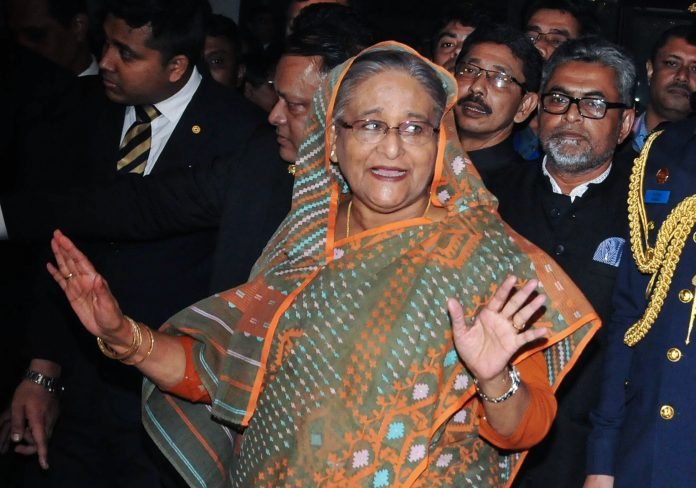
Sheikh Hasina, the ousted former Prime Minister of Bangladesh, declared that her return to the country hinges on the restoration of participatory democracy. Her comments came in a recent email interview with PTI from an undisclosed location in India. Hasina critiqued the current Yunus-led interim administration for jeopardizing Bangladesh’s relationship with India.
“I am immensely grateful to India’s government and its people for their kind hospitality,” she stated, thanking India for providing refuge during a tumultuous political period.
Hasina emphasized that the primary condition for her return is a political climate conducive to democracy. “The most critical prerequisite for my return—to Bangladesh—is the same condition that the Bangladeshi people advocate: a restoration of participatory democracy,” she asserted.
She demanded the interim government rescind the ban on the Awami League party and arrange for free, fair, and inclusive elections, stating, “Any election that excludes the Awami League will lack legitimacy.” Hasina underscored the necessity of representative governance in a country grappling with political unrest.
Since leaving Bangladesh on August 5, 2024, following weeks of violent anti-government protests, Hasina has remained vocal about the need for political stability. Acknowledging the government’s mishandling of the situation, she admitted, “We lost control of the situation and that was regrettable,” attributing the turmoil to politically motivated youth inciting violence.
In her assertion against claims of boycotting the upcoming polls, Hasina remarked, “Tens of millions of people support us… It would be a huge missed opportunity for a country that badly needs a government with genuine consent of the people.” This comments highlights her belief in the Awami League’s essential role in Bangladesh’s political landscape.
The former Prime Minister harshly criticized the Yunus administration, calling it chaotic and dependent on extremist influences. She warned that Yunus’ antagonistic stance towards India threatens the nation’s crucial diplomatic ties. “Yunus’ hostility to India is foolish and self-defeating… He is unelected and empowered by extremist forces,” she stated, urging for a more stable approach to bilateral relations.
“The interim government doesn’t represent what our people think,” she added, reiterating India’s vital role as a partner in Bangladesh’s progress.
In a dramatic turn, Hasina indicated her willingness to stand trial under international supervision, including before the International Criminal Court (ICC). She claimed that Yunus avoids such transparency because impartial scrutiny would favor her. Her criticism extended to local tribunals that have sought severe penalties against her, which she labeled as politically motivated attempts to eliminate her from the political arena.
“They want to eliminate us as political forces. The use of the death penalty to suppress opposition indicates their disregard for democracy and due process,” she criticized, implying systemic political oppression under the current regime.
Additionally, Hasina noted Yunus initially garnered backing from some Western liberals, but that support appeared to be dwindling as these allies recognize his intentions of consolidating power through radical inclusions in his governance.
In summary, Sheikh Hasina’s conditions for returning to Bangladesh center around democracy, political inclusivity, and the restoration of her party’s political rights. Her statements reflect an essential plea for stability not just for her return, but for the future of the Bangladeshi political landscape.