



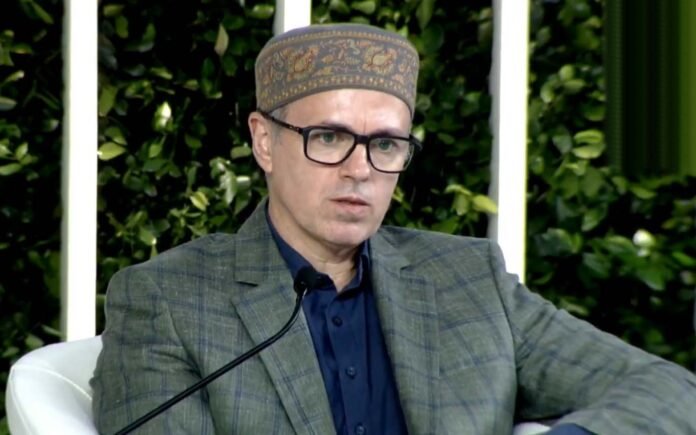
Jammu and Kashmir Chief Minister Omar Abdullah addressed his office’s challenges at a recent event, stating that he perceives it as one of ‘disempowerment’. Abdullah lamented the transition from leading a prominent State to managing a Union Territory, characterized by diminished powers compared to other Chief Ministers. He emphasized the need for clarity on statehood restoration.
During his speech, Abdullah unveiled his concerns about the current administrative framework in Jammu and Kashmir, criticizing the frequent interventions from the Lieutenant Governor’s office. He urged that the Centre must provide a clear, actionable timeline for restoring Statehood, lamenting the uncertainty that prevails.
Expressing frustration, he remarked, ‘I hate being reminded that we are a Union Territory.’ The emphasis on ‘Union Territory’ has escalated in discourse, contrasting sharply with his earlier term as Chief Minister when Statehood embodied pride for Jammu and Kashmir.
Power Struggle with LG Office
In his address, Abdullah highlighted an ‘asymmetrical’ power dynamic concerning the Lieutenant Governor, Manoj Sinha, who retains powers typically held by elected officials. Abdullah pointed out the contradictions in Governor Sinha convening meetings related to tourism while simultaneously overseeing security matters.
He criticized the appointment of an IAS officer to a position meant for Jammu and Kashmir Administrative Services (JKAS), perceiving it as an attempt to undermine the authority of the elected government over critical departments like Information.
Abdullah disclosed that significant cabinet decisions, including ones concerning reservation percentage modifications, linger with the Lieutenant Governor, illustrating a clear disconnect in governance. ‘There is an asymmetrical allocation of power between the elected and unelected government,’ he asserted.
Statehood and Article 370
As the dialogue around restoring Statehood intensifies, Abdullah reminded officials of the previously outlined three-step process; delimitation, elections, and Statehood. He questioned, ‘Two steps are complete. Why are we made to wait for the third?’
Pushing for clarity, Abdullah challenged the Centre to define its interpretation of ‘appropriate time’ regarding restoring Statehood. ‘If it is when the BJP comes to power, then be honest so people can decide,’ he remarked.
On the controversial Article 370, Abdullah expressed that its restoration seems implausible without a shift in central government dynamics. ‘It is pointless asking the people who took it away from us to give it back,’ he stated, reinforcing his commitment to the return of special status without making unrealistic promises.
Radicalisation and Governance
Abdullah cautioned against the trends of ‘hyper-nationalism’ and collective punishments, claiming these practices could fuel radicalisation. He criticized policies such as demolishing homes after terror attacks, citing the grasp of justice when consequence is incorrectly directed. ‘If those people are radicalized, whose fault is it?’ he questioned.
Moreover, Abdullah mentioned recent controversies regarding the selection of sports teams and medical college admissions, pointing out the objections raised against the majority of Muslim candidates, thereby pushing the community toward the margins.
National Politics and EVM Debate
In the broader political landscape, he criticized the current status of the INDIA alliance, likening it to being ‘in the ICU’ given that Article 370 does not feature on their agenda. He defended Rahul Gandhi’s political position, citing the need for electability before diving into contentious matters.
On the subject of EVM (Electronic Voting Machines) tampering accusations, Abdullah brought a refreshing perspective, differing from his father, Farooq Abdullah. He stated, ‘I believe we should own our defeats and correct our mistakes,’ attributing electoral disadvantages to constituency delimitation.
Economy, Environment and Tourism
Earlier in his remarks, Abdullah also ventured into environmental issues, including pollution and prolonged dry spells affecting the valley. He noted the geography of Srinagar aggravates pollution levels. He clarified a misconception around tourism being the primary economic source of Jammu and Kashmir, explaining that it ranks fourth in the Gross State Domestic Product contributions, following agriculture, horticulture, and industry.