



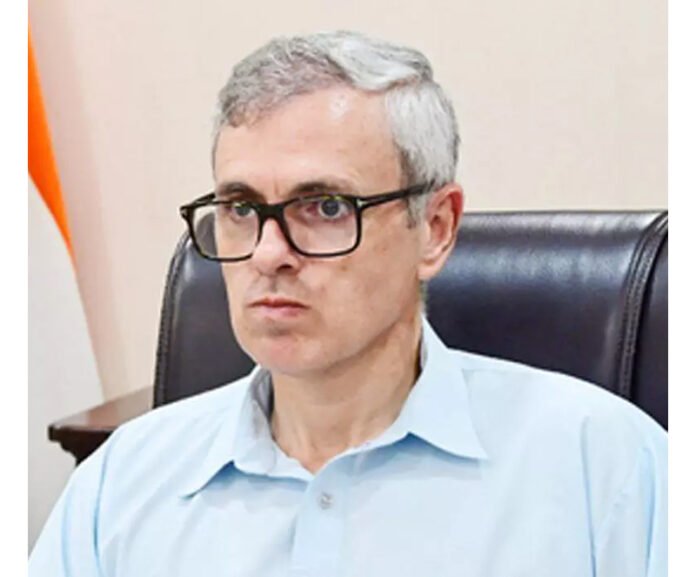
Jammu and Kashmir Chief Minister Omar Abdullah has urged Bihar Chief Minister Nitish Kumar to apologise for an incident in which Kumar pulled down a woman doctor’s veil during a government function. This incident occurred on Monday at the Bihar Secretariat and has ignited widespread controversy.
Abdullah condemned Kumar’s actions, calling them unacceptable. The incident transpired at an appointment letter distribution ceremony for AYUSH doctors when Kumar reportedly interacted with the woman by remarking, “What is this?” before adjusting her naqab. Abdullah posed a rhetorical question to reporters: “Would you do such an act? I would not.” He further noted that the doctor has refused the appointment and will not take up government service.
In a firm statement, Abdullah insisted that Kumar must apologise and encourage the doctor to accept her position. He articulated his criticism towards BJP leader Giriraj Singh, who defended Kumar, suggesting that expectations from the ruling party regarding women’s dignity were misguided.
Abdullah pointed out the double standards, stating, “If a Muslim leader had touched the veil of a Hindu woman in Haryana or Rajasthan, there would have been a huge uproar. But since the woman here is Muslim, the BJP finds nothing wrong.” He emphasised that the issue transcends religion, focusing instead on the principles of dignity and respectful conduct.
Addressing the press, Abdullah asked, “How can anyone touch a woman’s clothes like this? Why did the Chief Minister feel the need to do so?” He consistently called for Kumar to recognise his error and offer a sincere apology.
Political Commentary and National Identity
On another note, Abdullah responded to Congress leader Prithviraj Chavan’s recent comments on Pakistan’s aerial capabilities. Abdullah indicated that Chavan’s statements reflected personal views rather than an official party stance. “The Congress and other opposition parties stood firmly with the government and the defence forces after the Pahalgam terror attack,” he clarified.
During his visit to Patna, Abdullah participated in the 11th edition of the India’s International Movement to Unite Nations (IIMUN) Role Model Series, sharing insights about the “idea of India.” He reflected on Jammu and Kashmir’s historical decision to accede to India, stressing the significance of that choice for national identity.
“I come from a Muslim-majority State that could have opted for Pakistan but chose India instead,” Abdullah stated. He elaborated on the essence of the “idea of India,” highlighting the need to protect the values that bind the nation together. While he acknowledged diverse interpretations of this idea, he reaffirmed the importance of democracy and continuous discourse.
Abdullah also addressed recent controversies surrounding school admissions and sports selection in Jammu and Kashmir. Reacting to debates based on religious identity, he commented on the disproportionate representation in both medical college admissions and sports teams.
He pointed out that out of 50 students admitted to the Vaishno Devi Medical College’s first MBBS batch through NEET, 42 were Muslims. Abdullah stated that discussions surrounding admissions must focus on talent rather than religious affiliation. He declared, “The only balance that should matter is between the talented and the untalented.”
Finally, Abdullah voiced a vision for an equitable future, stating, “The India I want for our children is one where merit alone decides how far they go—nothing else.” This vision encapsulates his commitment to ensuring that opportunities depend on ability, not identity.