



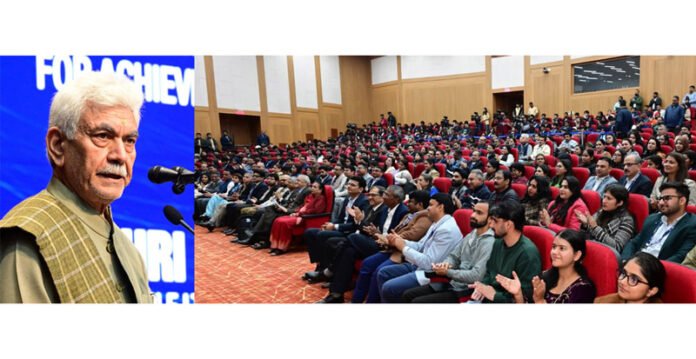
Lieutenant Governor Manoj Sinha announced on Monday that large parts of India have achieved a near terrorism-free status, particularly highlighting the northeast and Jammu and Kashmir. This declaration came during his address at the three-day Strategic Management Forum (SMF) Conference at the Indian Institute of Management (IIM), Jammu, focusing on policy-making for a Viksit Bharat by 2047.
Sinha emphasized that most of the northeast is now terrorism-free, with only a few pockets remaining affected. He stated, “The threat of left-wing extremism and Naxalism has been significantly curtailed,” indicating a sharp decline in violence across the country.
In his address, Sinha noted a dramatic drop in local recruitment for terrorism in Jammu and Kashmir. He reported, “Hardly one or two youths are being recruited now,” indicating a shift in the region’s dynamics against terrorism. However, he warned of ongoing infiltration attempts by Pakistan-based terrorists.
“Those entering from across the border are currently hiding in dense forests and rugged terrains,” Sinha said. He affirmed, “I assure you they will be eliminated. No matter how long it takes, they will not survive.” His assertion highlights a renewed commitment to national security.
Addressing the changing nature of terrorism, Sinha pointed out that both educated and informed individuals are becoming involved. He stressed the need for collaboration among the society, security forces, and administration in fighting this scourge, particularly in regions impacted by violence.
Moreover, he urged for an end to the “insider-outsider” narrative, which he believes hampers development efforts in affected areas. He stated, “This divisive thinking creates hurdles in the development process.” Sinha’s comments signal a need for unity in rebuilding efforts.
During the Forum, Sinha laid out a vision for India’s development aimed at achieving the Viksit Bharat 2047 goal. He called on policymakers and business leaders to confront emerging challenges proactively.
“Our focus should be on macroeconomic stability, increased investments in education and health, and embracing digital tools for participatory governance,” he asserted. His remarks reflect an urgent call for forward-thinking strategies to bolster India’s economic resilience.
Sinha also praised the rapid growth under Prime Minister Narendra Modi’s leadership. He noted, “Industry leaders show renewed confidence as sectors such as manufacturing and handicrafts compete globally,” further emphasizing the Swadeshi movement’s importance in revitalizing local industries.
The Lieutenant Governor recognized Jammu and Kashmir’s untapped economic potential, particularly in the mining sector. He mentioned, “J&K has immense reserves of limestone, sapphire, and lithium. With strategic planning, we could generate Rs 15,000 crore to Rs 20,000 crore annually in the next five to seven years.” This assertion highlights the region’s wealth and opportunities.
Additionally, he advocated for maximizing the hydropower sector’s capabilities and suggested adapting the Holistic Agriculture Development Programme (HADP) to address evolving economic needs.
On a cultural note, Sinha unveiled the Basohli Painting Exhibition, honoring the intrinsic value of this traditional art form. “Basohli Painting is a priceless artistic heritage for current and future generations,” he said, commending the collaborative effort between IIM Jammu and the Indira Gandhi National Centre for the Arts (IGNCA).
The Strategic Management Forum event attracted various dignitaries, including Prof B.S. Sahay, Director of IIM Jammu, and Subash Chandra Meena, Economic Advisor at NITI Aayog. Their presence underscores the collaboration between academia and policy-making.