



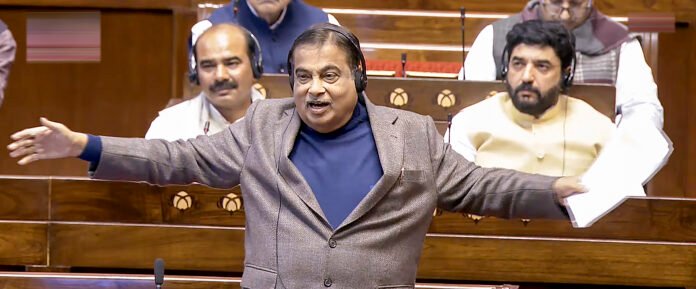
Union Minister for Road Transport and Highways, Nitin Gadkari, announced on Wednesday that India will implement the Multi-Lane Free Flow (MLFF) toll system and AI-based highway management technologies by the end of 2026. This ambitious project aims to enhance road efficiency and significantly reduce waiting times at toll plazas across the nation.
Addressing the Rajya Sabha during the Question Hour, Gadkari emphasized that the new tolling mechanism will harness Artificial Intelligence, satellite technology, and license plate recognition. These advancements will enable vehicles to traverse toll points without stopping, thereby ensuring a smooth flow of traffic.
Under the MLFF system, commuters will see remarkable changes. “With MLFF, vehicles will not have to stop at toll plazas and can pass through at speeds of up to 80 km per hour,” Gadkari stated, highlighting that this new system will eventually replace the existing FASTag mechanism.
Previously, toll payments took an average of three to ten minutes. After the introduction of FASTag, this time reduced to under a minute. Gadkari noted that this change increased toll revenue by at least ₹5,000 crore. He expressed confidence that MLFF will further enhance this system, stating, “Our goal is to bring waiting time down to zero minutes.”
The Minister also discussed the economic benefits of implementing the MLFF system. He predicted that it could lead to fuel savings of approximately ₹1,500 crore and generate an additional ₹6,000 crore in government revenue while mitigating toll leakage and theft.
Gadkari assured the members of the House, “By 2026, this work will be completed 100 percent. Once implemented, toll theft will end, transparency will increase, and commuters will not face any inconvenience at toll plazas.”
Furthermore, he mentioned that AI-enabled technology would dramatically enhance travel time and overall highway efficiency, providing a more satisfying experience for commuters.
While addressing concerns regarding highway management, Gadkari clarified that the central government oversees only national highways. He said the government does not maintain state highways or urban roads, which are frequently misattributed to national highway issues on social media.
Gadkari emphasized, “We are making every effort to ensure a transparent, efficient, and corruption-free system.”
This announcement marks a significant milestone in modernizing India’s highway infrastructure. The government’s commitment to the MLFF toll system illustrates a robust approach to improving the convenience and efficiency of travel for millions of road users nationwide.